Hosted PBX Explained for Modern Businesses
The way businesses communicate has undergone significant changes over the past two decades. From switchboards and desk phones to unified digital systems, communication tools have evolved to meet the demands of flexibility, mobility, and efficiency.
In the early days, Private Branch Exchange (PBX) systems served as the backbone of business communications. These on-site systems managed internal call routing and external lines, but they required expensive hardware and technical upkeep. While traditional PBX systems helped businesses stay connected within physical offices, they were not built for the fast-paced, remote-ready world we live in today.
Now, small and mid-sized businesses are looking for solutions that are smarter, leaner, and more adaptable. That’s where hosted PBX systems come in — a modern, cloud-based evolution of traditional PBX technology that offers flexibility, scalability, and cost-efficiency for organizations of all sizes.
What Is a Hosted PBX?
A hosted PBX is a type of business phone system that operates over the internet, rather than relying on hardware installed at your office. The “hosted” aspect means that the system is managed off-site by a service provider, who handles all updates, maintenance, and performance monitoring.
Unlike traditional systems, which use physical phone lines to route calls, a hosted PBX utilizes Voice over Internet Protocol (VoIP) technology to transmit voice and data over a broadband connection. This allows users to make and receive calls, join meetings, and manage voicemail through computers, smartphones, or VoIP-enabled desk phones.
In essence, a hosted PBX replaces the complexity of physical equipment with the convenience of cloud-based management. For business owners, this means fewer costs, fewer technical headaches, and far greater control over how your team communicates.
To better understand the difference between older PBX setups and modern hosted systems, explore our guide on What Is VoIP and How Does It Work for Business. It explains how internet-based communication reshaped the way businesses operate and why so many are making the switch.
Benefits of Hosted PBX Systems
Hosted PBX systems are designed to provide practical advantages for modern businesses. Beyond just simplifying communication, they create efficiency across your entire organization.
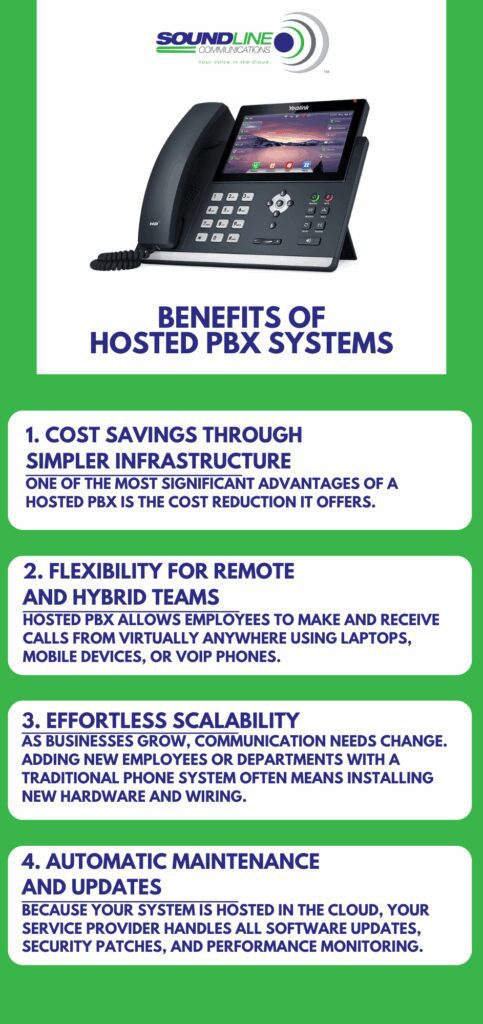
1. Cost Savings Through Simpler Infrastructure
One of the most significant advantages of a hosted PBX is the cost reduction it offers. Traditional PBX systems require heavy upfront investments in servers, wiring, and IT support. When something breaks or becomes outdated, maintenance costs add up fast.
Hosted PBX eliminates these expenses. Instead of buying hardware, your provider hosts the infrastructure for you. This shifts your spending from significant capital expenses (CAPEX) to manageable operating expenses (OPEX). You only pay for the number of users and features you need, which makes budgeting more predictable and easier to scale as your business grows.
2. Flexibility for Remote and Hybrid Teams
Today’s workforce expects communication to be mobile. Hosted PBX allows employees to make and receive calls from virtually anywhere using laptops, mobile devices, or VoIP phones. Teams in different offices — or even different states — can share the same phone system, featuring the same set of capabilities.
For small and mid-sized businesses, this flexibility is invaluable. Whether you’re managing field agents, a hybrid team, or a fully remote operation, a cloud PBX ensures that everyone stays connected under one consistent business identity.
3. Effortless Scalability
As businesses grow, communication needs change. Adding new employees or departments with a traditional phone system often means installing new hardware and wiring. With a hosted PBX, scaling is simple. You can add or remove users instantly through a cloud dashboard, without waiting for technicians or new equipment to arrive.
This scalability also works in reverse — if your team size fluctuates seasonally, you can reduce your plan to match your needs without penalty or wasted resources.
4. Automatic Maintenance and Updates
Because your system is hosted in the cloud, your service provider handles all software updates, security patches, and performance monitoring. There’s no need to schedule downtime or worry about system compatibility. Your phone network always runs on the latest, most secure version available.
This also means your internal IT team can focus on higher-value tasks instead of routine maintenance.
Use Cases and Industries That Benefit
A hosted PBX system isn’t limited to one industry or business type. It supports a wide variety of organizations — from local service companies to nationwide franchises — that need reliable, high-quality communication without unnecessary complexity.
Remote Teams
Businesses with remote or mobile employees benefit immediately. Hosted PBX systems enable staff members to answer calls, transfer calls, and check voicemail from any connected device. This creates a seamless communication experience, even when teams work from different locations.
Franchises and Multi-Location Businesses
Companies with multiple branches often face challenges in coordinating communication across their various sites. Hosted PBX systems consolidate all locations under a single, centralized system. Calls can be routed automatically based on location, department, or availability, making it easy to maintain consistency and manage call analytics in one place.
For more insight into how this works, read “Multi-Office VoIP Setup Made Simple,” which explains how centralized communication enhances collaboration across locations.
Startups and Growing Companies
Startups often prioritize agility and cost-effectiveness. Hosted PBX provides access to enterprise-level features without requiring significant investments in infrastructure. As they grow, they can expand their phone system with minimal effort, ensuring communications evolve alongside the business.
Setup Requirements
Implementing a hosted PBX is straightforward; however, a few key factors are essential to ensure optimal performance and reliability.
1. Reliable Internet Bandwidth
Because hosted PBX relies on the internet, a strong and stable connection is essential. Each call typically requires a small amount of bandwidth, so providers can help assess your network’s capacity to ensure clear audio quality and minimal latency.
For businesses in regions such as Seattle, Bellevue, and across the Pacific Northwest, Soundline Communications offers VoIP systems optimized for local performance, ensuring reliable connectivity even during peak call volumes.
2. Compatible Phones or Softphones
You can choose between using traditional VoIP-enabled desk phones or “softphones,” which are software-based applications that run on computers or mobile devices. This flexibility enables businesses to select the setup that best suits their workflow, whether in-office or remote.
3. Onboarding and Setup Support
A hosted PBX system is designed for fast deployment. Providers like Soundline handle configuration, number porting, and employee training to ensure minimal disruption during the installation process. In most cases, onboarding can be completed within a few days.
To explore options for your business and compare plans, visit our Features and Pricing pages.
Is Hosted PBX Right for Your Business?
A hosted PBX system is a significant upgrade for most small and mid-sized businesses; however, it’s essential to evaluate your current setup before making the switch.
Questions to Ask Before You Switch
- Does your business rely on mobile or hybrid communication?
- Are you spending too much on phone maintenance or upgrades?
- Is your team expanding, or are you managing multiple offices?
- Do you want to improve customer response times or call routing efficiency?
If the answer to any of these questions is yes, a hosted PBX may be a great fit.
When a Traditional System Holds You Back
Legacy phone systems often become more of a burden than an asset. If your business experiences frequent downtime, outdated equipment, or high repair costs, those are signs it’s time to modernize. Hosted PBX not only removes these barriers but also future-proofs your communication system against evolving technology trends.
Conclusion
Business communication no longer needs to be tied to physical equipment or limited by outdated systems. A hosted PBX combines flexibility, affordability, and advanced functionality into one seamless solution.
With this technology, businesses can connect remote employees, manage multiple locations, and adapt quickly to changing needs — all while reducing maintenance costs and improving performance.
Soundline Communications empowers businesses across Seattle and beyond with reliable, cloud-based phone systems designed for real-world performance and growth. Whether you’re upgrading from an on-premise PBX or starting fresh, our team ensures your transition is smooth, secure, and scalable.
Ready to experience the difference a hosted PBX can make?
Request a Demo today and discover how Soundline can help your business communicate smarter.
Frequently Asked Questions
What’s the main difference between a hosted PBX and an on-premise PBX?
A hosted PBX is managed in the cloud by your provider, while an on-premise PBX requires physical servers and internal maintenance. Hosted systems remove the need for in-house equipment, making them more cost-effective and flexible for modern businesses.
Can I keep my existing phone numbers when switching to hosted PBX?
Yes. Your provider can transfer, or “port,” your existing numbers to the new system without disrupting your operations. The process typically takes only a few business days, depending on your current carrier.
How secure is a hosted PBX system?
Hosted PBX platforms use advanced encryption, firewalls, and continuous monitoring to protect your calls and data. Providers like Soundline also handle all security updates automatically, ensuring your business communications remain safe and compliant.